Color Theory, Meet Your Closet: The Real Science Behind Dressing for Joy
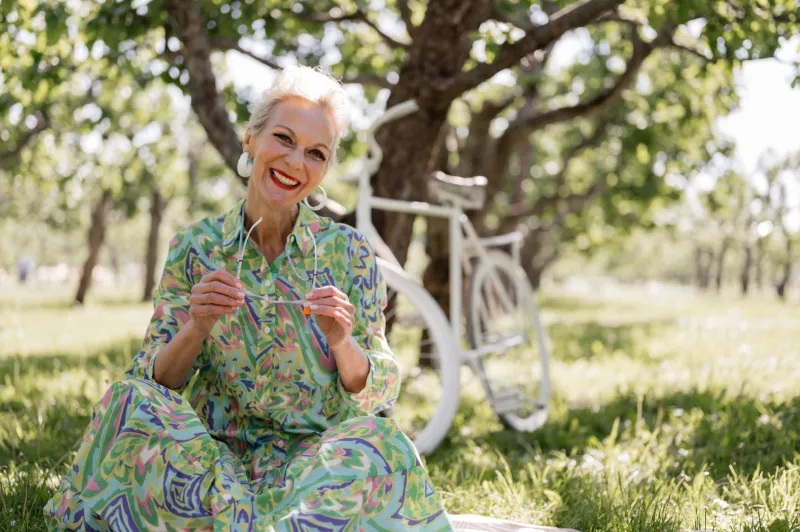
There's a moment a lot of us know well: you're dragging yourself out of bed on a rough Monday, reach for the same gray hoodie you always grab, and then — something stops you. You pull out that electric blue wrap dress instead, the one that's been hanging there waiting for a "special occasion." You wear it to the grocery store. Three strangers compliment you. You feel, weirdly, like yourself again.
That's dopamine dressing in a nutshell. But is it real? Or is it just a catchy TikTok concept dressed up in pseudo-science?
What Fashion Psychology Actually Says
The short answer: it's more legit than the skeptics want to admit.
Dr. Dawnn Karen, a New York-based fashion psychologist and author of Dress Your Best Life, has spent years studying the relationship between clothing choices and emotional states. Her research points to something called "enclothed cognition" — a term coined by researchers Hajo Adam and Adam Galinsky in a 2012 Northwestern University study. The basic idea is that the clothes we wear don't just signal things to other people; they send signals to ourselves. When you put on something that carries meaning — power, playfulness, confidence — your brain starts to behave accordingly.
"Color is one of the most immediate and visceral tools we have," Karen has explained in interviews. "Warm colors like red and orange can activate energy and assertiveness. Softer, cooler tones like lavender or sage can create a sense of calm. It's not magic. It's psychology."
And it's not just anecdotal. A 2021 study published in the Journal of Positive Psychology found that wearing "happy" clothes — defined by participants as bright, well-fitting, and personally meaningful — was associated with increased feelings of positivity and confidence. Not dramatically so, but consistently.
The Trend Behind the Trend
Dopamine dressing as a named phenomenon really exploded post-pandemic. After months of sweatpants and survival mode, people emerged with a hunger for color, texture, and joy — and fashion responded. Designers like Christopher John Rogers and Molly Goddard became household names in style circles for their commitment to volume, color, and unapologetic vibrancy. Brands that had been leaning into minimalism suddenly found themselves competing with a wave of maximalist energy that didn't feel like it was going anywhere.
Stylelist and creative director Kat Collings, who works with clients in Los Angeles and New York, says the shift was unmistakable. "My clients started coming to me asking for pieces that made them feel something. Not just look polished. They wanted clothes that had an emotional charge to them."
She's quick to note, though, that dopamine dressing isn't one-size-fits-all. "For some people, a neon green co-ord set is the most joyful thing in the world. For someone else, it's a perfectly structured camel coat in the most luxurious fabric they've ever touched. Joy isn't always loud."
Real People, Real Wardrobes
We asked a handful of fashion-forward consumers across the US to share what's actually in their mood-boosting rotation — and the results were as varied as you'd expect.
Marcus, 29, a graphic designer in Atlanta, swears by color-blocked streetwear. "When I'm in a monochrome red outfit, I walk differently. I don't know how else to explain it. I just feel like I'm operating at a higher level."
Sophia, 34, a teacher in Chicago, goes a different route. "My dopamine piece is this vintage silk blouse with a wild floral print. It's not trendy. But every time I wear it, I feel like the most interesting person in the room."
And then there's Devon, 26, a non-binary writer in Portland, who described their relationship with color as "a conversation with myself." "I use color to tell myself what kind of day I'm going to have. Yellow means I'm ready to be social. Black means I need to focus and I don't want to be bothered. It's like a mood ring, but I get to design it."
How to Build a Mood-Boosting Wardrobe (Without Burning It Down First)
You don't have to overhaul everything. In fact, fashion psychologists suggest starting small and intentional.
Start with one statement piece. Choose something in a color or silhouette that genuinely excites you — not one you think should excite you. There's a difference. If chartreuse makes you feel alive, great. If a deeply saturated burgundy velvet blazer is your thing, lean in.
Pay attention to what you reach for on good days. Most of us have a "good day outfit" we don't even consciously register. Start there. What are those pieces? What do they have in common? That's your dopamine blueprint.
Think about fit as much as color. Ill-fitting clothes, no matter how vibrant, can undermine confidence. A well-tailored silhouette in a muted tone can do more for your mood than a neon dress that doesn't feel right on your body.
Don't outsource your joy to trends. This is the trap. Dopamine dressing works because it's personal. If you're buying a lime green puffer because it's everywhere, but it doesn't actually spark anything in you, it's just another piece you'll stop reaching for.
Give yourself permission to dress for right now. Stop saving things for special occasions. The act of wearing something you love on an ordinary Tuesday is, itself, the point.
The Bigger Picture
Dopamine dressing matters beyond the individual closet. It's part of a broader cultural reckoning with what fashion is actually for. For too long, the industry pushed a narrative that style was about external validation — impressing others, signaling status, following rules. What's exciting about this moment is the growing insistence that clothes can be a tool for internal experience, for self-expression, for genuine emotional wellbeing.
Is a bold outfit going to cure a bad day? No. But the idea that what you wear is disconnected from how you feel? The science doesn't really support that either.
Your closet is already talking to you. It might be time to start listening.